Wow, if you like trains you're in train heaven here as the National Railway Museum houses over 100 locomotives, over 300 items of rolling stock (passenger carriages) and warehouses full of train memorabilia spread over 20 acres.
This monster-size locomotive was built in England but shipped over to China where it was a workhorse for many years.
Passenger carriages used by English royalty are displayed. Though you can't go in the carriages you can peer in the windows--however my photos taken through the windows had too much glare.
Make no mistake, the furnishings inside the carriages are opulent--fit for a king or queen.
So much train memorabilia to see. One could spend days here.
There's an elevated walkway going across this room so visitors can watch work being done on locomotives.
Wednesday, August 16, 2017
Monday, August 14, 2017
York, England
Wow, York's city center is still enclosed by a medieval wall. Tourists can walk atop the wall all the way around---we're talking two and a half miles.
Tourism is one of York's (population 210,000) biggest industries.
Notice the very narrow streets--this street lays claim to being the oldest shopping street in Europe.
Why are the streets so narrow? Butchers displayed carcasses hung on hooks outside their shops and having the street mostly in the shade kept the meat from going bad (or so they say).
York Cathedral is huuuge--it's the second largest Gothic cathedral in Northern Europe. Heck, I can't even get the whole thing in a single photo frame. Inside, there's the largest expanse of medieval stained glass in the world.
Clifford's Tower is pretty much all that's left of York Castle. Used as a lookout and prison.
Why this photo of Bakes & Co., a deli/coffee bar? See next photo.
As you know I have a sweet tooth and I'm ALWAYS checking out places for goodies. Well, I hit the jackpot here as their ginger crunch bars are dangerously good! One of the owners said his mom makes the bars and it's a family recipe. I had one, went back and got three more. The next day I returned and bought four more. Click on the photo and it'll enlarge.
Some of the buildings are just fun to look at the details.
York is one of the very few cities to still have all their medieval gateways still standing.
I'm cycling a half-dozen miles from York and come across Bishopthorpe Palace. This palace is where the Archbishop of York (second highest office of the Church of England) hangs his hat.
Bishopthorpe is a private residence (meaning: no trespassing) so I snap this photo from the entrance gate.
Bishopthorpe Palace backs up to the river--nice digs.
Cycled past York Racecourse. They've been staging horse races here since 1754.
After Ascot, York Racecourse is biggest in Great Britain. The stands can seat 60,000 spectators.
Trivia: In 1982 Pope Benedict XVI visited York Racecourse and drew a crowd of 190,000. Plus, the second day of the 2014 Tour de France started here.
Friday, August 11, 2017
Newcastle, England
Newcastle (population 300,000) lies about 280 miles north of London and 50 miles south of the Scottish border. It was a 10 mile bicycle ride from Newcastle's airport to the city center and I adjusted to cycling along the "wrong side" of the road. I'm sure you know in England they drive on the opposite side.
The Tyne River flows through Newcastle and the bridge in the forefront is the Gateshead Millennium Bridge. What's unusual about this bridge? It's not the fact it's for pedestrian's and cyclists only but, it can be tilted to allow ships through.
Farther along the river is the red Swing Bridge. Built in 1876 the bridge swings open to allow ships to pass on either side. Back in the 1800's and early 1900's Newcastle was a powerhouse in shipbuilding and in coal mining. In its heyday over 20,000 workers worked on the docks building warships, merchant ships and, coal carrying ships. Fifteen miles upstream the Tyne River empties out to the North Sea.
I like the black rabbit peering down atop the entrance to this office building.
A canal splits off from the Tyne River and passes by a former chemical building from the 1900s.
Spotted this boat contraption docked along the canal in front of former factory building.
Beautiful downtown Newcastle shopping arcade from a different era.
I'm cycling around an iffy residential area and come upon this sign reading "no fly tipping". What the heck does that mean?
Does this sign help? A local tells me "fly tipping" means driving past in a car and tossing trash out the window.
I cycle 15 miles from Newcastle along the Tyne River to Tynemouth (population 68,000). Yep, Tynemouth is located at the mouth of the Tyne River--hence the town's name. Castle ruins.
Here's the beach at Tynemouth and that's the cold North Sea.
Another view of the castle ruins.
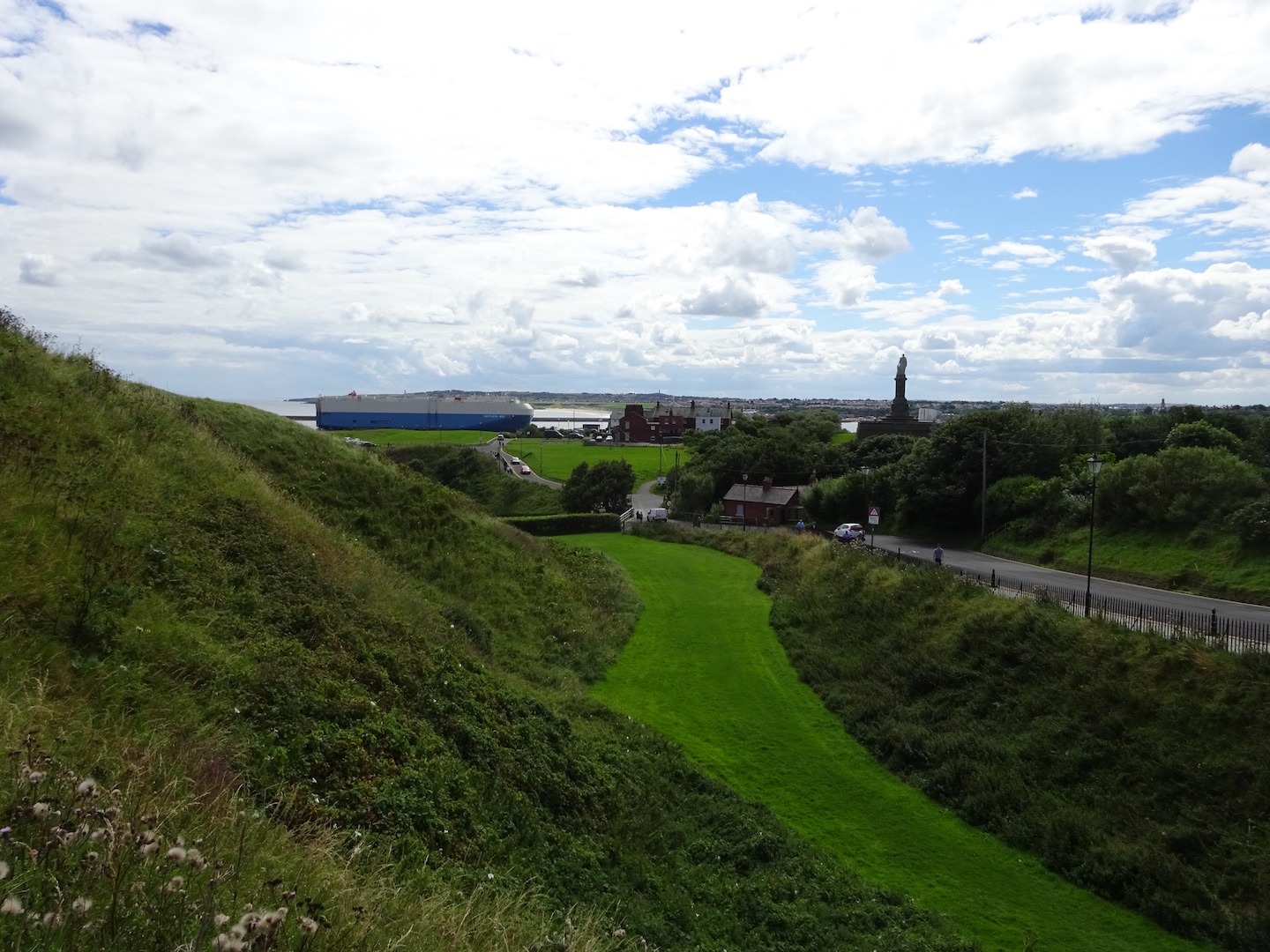
That's a big cargo ship making its way up the Tyne River. Several large cruise ships were parked nearby.
Monday, June 19, 2017
Chateau spotting along the Loire River in France
The Loire Valley is known for its spectacular chateaux and there're something like 300 of them. Chateau de Chaumont-sur-Loire dates back to the 10th century.
Entrance to Chateau Chaumont.
Courtyard view.
I've been to hundreds of castles and seen many, many horse stables but, this one at Chateau Chaumont dates back to the 1870's is a real beaut.
The collection of harness and saddlery equipment is considered the finest in France.
Arriving in Blois you don't have to ask for directions to Chateau Blois because the 564 room castle isn't hard to find as it dominates the town center.
Residence to several French kings, over the years parts of Chateau Blois were done in Classic, Renaissance and Gothic style. Notice the spiral staircase in the courtyard.
Same courtyard but different building style.
A road runs along each side of the River Loire and you have to plan accordingly because bridges are far apart and if you are on wrong side--it could set you back lots of miles--especially if you are cycling! I snapped a photo of this chateau on the other side of the river and am pretty sure it wasn't open to the public---which most are not.
Chateau Chambord is the most famous chateau in the Loire Valley and one of the most visited sites in France. Built between 1519-1547 by King Francis I to be a hunting lodge the king rarely used the 440 room getaway.
Done in French Renaissance style, the Chateau Chambord opens at 9AM. I arrive at 9AM and the tour buses were already rolling in. It receives more than 700,000 visitors a year. What's funny is that it's located about six miles from the River Loire--so no river view.
Backside where tourists enter the chateau.
Side view of Chateau Chambord. Didn't think the grounds were anything special. However, a 13,000 acre park (formerly the king's hunting park) encompasses the chateau. The French government has owned the chateau, grounds and hunting park since 1930.
Subscribe to:
Posts (Atom)