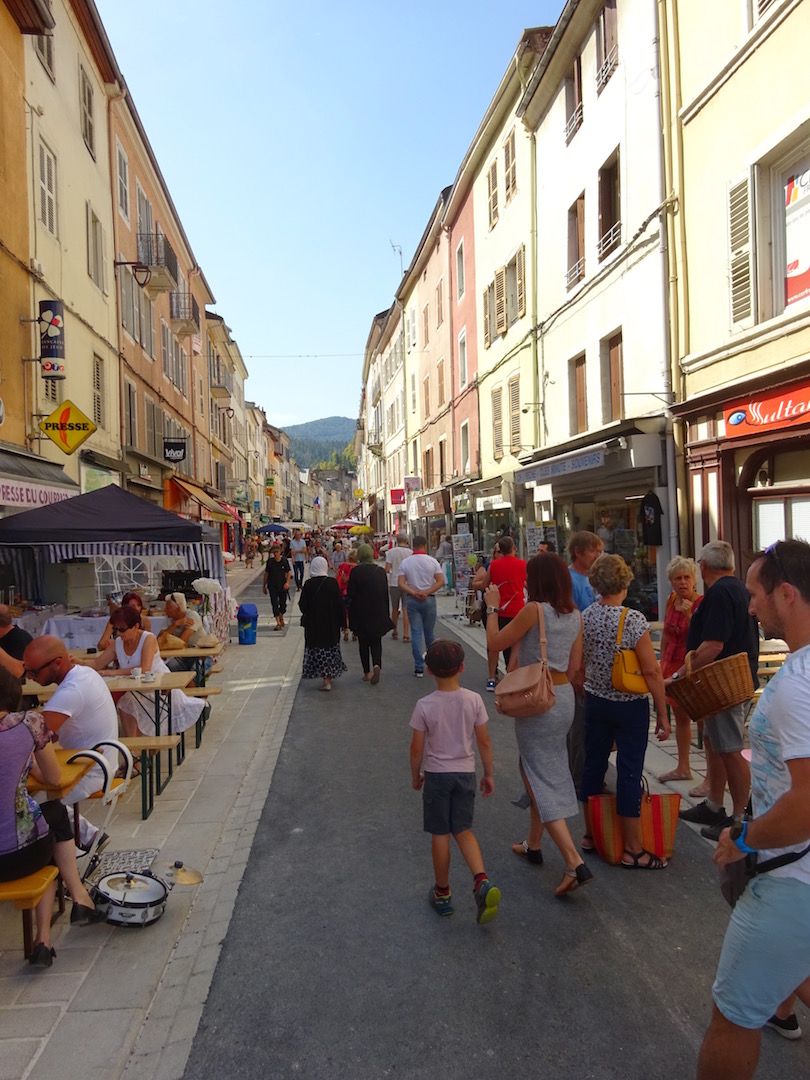
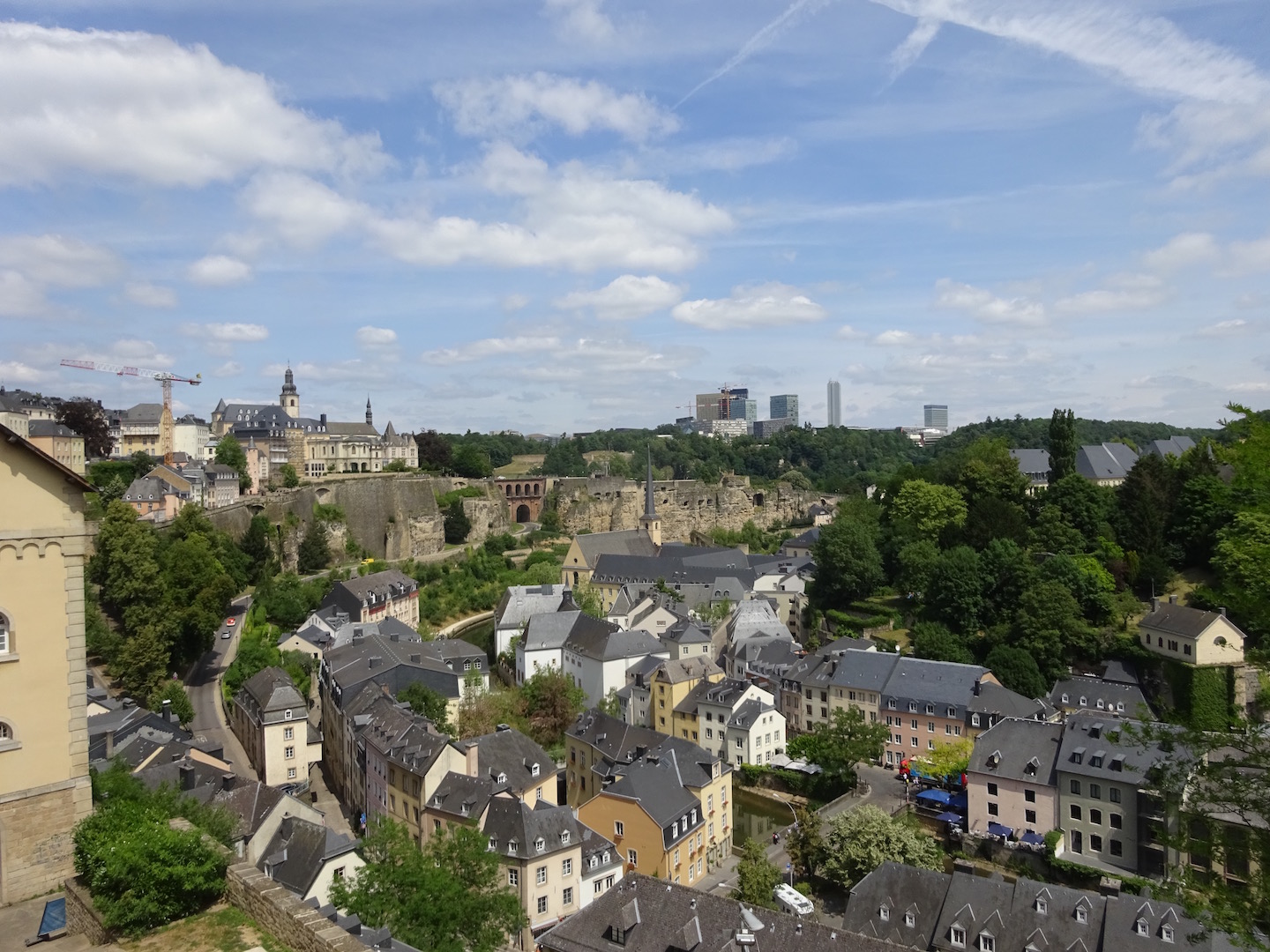
It's Saturday and there's a weekend festival in downtown La Chaux-de-Fonds, population 38,000. The main drag through town is blocked off with food stalls and a carnival taking over. That would probably explain why there's no water spraying out of this beautiful fountain---note the turtles. **Don't forget you can click on each image and it'll enlarge. Nestled in a valley smack dab in the middle of the Jura mountains, La Chaux-de-Fonds is also known as the "Siberia of Switzerland". From what I've heard winters can be long, cold and overcast (yikes!).
The whole city of La Chaux-de-Fonds has been designated a UNESCO site. Le Corbusier (1887-1965), one of the world's most famous architects was born here. This house is is called "Maison blanche" or White house. Le Corbusier designed the house in 1911.
Le Corbusier was only 24 years old when designed "Maison blanche". Who was the house for? His parents. By the way, his parents had to move out after 10 years to a more affordable modest home down the steep hillside.
Just around the corner from "Maison blanche" is another of Le Corbusier's works. Villa Jaquemet was built in 1908. Jeez, Le Corbusier was only 21 years old!
It's fun cycling along the heavily forested steep hillsides of the city.
These aren't fancy villas like the two Le Corbusier properties but, quite a few wood chalets are tucked away in the forest.
Why the heck would these people want a Tyrannosaur rex in their front yard is beyond me!
A half-block from the Tyrannosaur rex stands this cool-looking watchtower(?) home with a clock face in the middle. How old is it? Does somebody live there? Down the street I meet an older couple in their front yard---who look like they've lived there for years. The wife speaks English and says she knows nothing about the place except that it's part of a compound located on the other side of a deep canyon. Jeez, how could this couple not be curious of its history?
So, I make my way around the canyon to find this view. I wonder if the tower is used as a guest cottage?
This street is named Rue Louis-Joseph-Chevrolet. Why? Louis Chevrolet (1878-1941), co-founder of the Chevrolet Motor Company in 1911, was born in La Chaux-de-Fonds.
The main fire station in La Chaux-de-Fonds is having an open house today and showing off all their fire fighting equipment including new and old trucks. I'm dating this one from the 1960's?
Thursday, September 5, 2019
Saturday, August 17, 2019
Lake Zurich, Switzerland Part Two
On the edge of Rapperswil (population 27,000) a farmer has gone whole hog to sell his wares.
It's somewhat common finding self-service vending machines near farms dispensing fresh milk. In France I've come across many boulangeries with vending machines outside their shops for after hours shoppers who need their baguette fix. But, this farmer has gone big time with his offerings. I count 66 items for sale including apricots, cherries, apples, juices, various jams and bottles of wine.
All the goodies look to be home made. But what about the wine for sale? Go to next photo.
The wine is from the farmer's hillside vineyard located just a few yards away.
A view of downtown Rapperswil. Zurich (population 400,000) anchors one end of the lake and Rapperswil anchors the other end.
Another view of Rapperswil and its castle.
A nice day for boating on the lake.
People in Zurich seem to have a thing for placing statues on their balconies.
This couple is naked.
This wooden chicken rules the roost.
Wood carving in downtown Zurich.
The Limmat River flows through Zurich's city center. Part of it has been diverted and turned into a humongous fresh water, slowly flowing swimming pool for the locals. Many office workers grab a quick swim during lunch.
This Italian coffee shop/bakery is my "go to" place for pastries in Zurich. They have absolutely the best cannoli.
It's somewhat common finding self-service vending machines near farms dispensing fresh milk. In France I've come across many boulangeries with vending machines outside their shops for after hours shoppers who need their baguette fix. But, this farmer has gone big time with his offerings. I count 66 items for sale including apricots, cherries, apples, juices, various jams and bottles of wine.
All the goodies look to be home made. But what about the wine for sale? Go to next photo.
The wine is from the farmer's hillside vineyard located just a few yards away.
A view of downtown Rapperswil. Zurich (population 400,000) anchors one end of the lake and Rapperswil anchors the other end.
Another view of Rapperswil and its castle.
A nice day for boating on the lake.
People in Zurich seem to have a thing for placing statues on their balconies.
This couple is naked.
This wooden chicken rules the roost.
Wood carving in downtown Zurich.
The Limmat River flows through Zurich's city center. Part of it has been diverted and turned into a humongous fresh water, slowly flowing swimming pool for the locals. Many office workers grab a quick swim during lunch.
This Italian coffee shop/bakery is my "go to" place for pastries in Zurich. They have absolutely the best cannoli.
Friday, August 16, 2019
Lake Zurich, Switzerland Part One
In this photo you can see Lake Zurich in the distance. It's about a 60 mile bike ride around the lake. Steep hillsides rise up around most of the lake. Densely populated towns and villages line the shore. However, get above the ridge line of the hills and it's sparsely populated with beautiful farmland. I live in southern Switzerland (French-speaking part) and every summer my bike and I head up to northern Switzerland (German-speaking part) and do some exploring. These are photos from around the lake.
Lots of farms and cows. These are "normal" cows--- you know the ones for milk, cheese and chocolate.
Believe it our not, these are Texas Longhorns. What the heck are they doing in Switzerland? (check out the huge horns). There's a sign posted on the fence (it's in German) but I see the words "Texas Longhorns".
This house has lots of flowers. Click on the photo to to enlarge.
These goats climbed up on the roof to get a better look at me.
Cycling the back roads take you past farms with self-service stalls (you pay via the honor system).
House flying the Swiss flag.
So, I've been cycling past this place for years. Note the building scaffolding on the left. Story continues with next photo.
For years it was an abandoned former hydraulics factory. Located smack dab in the middle of a residential area way above Lake Zurich. Any property around Lake Zurich is mucho bucks. About four years ago I saw renovations going on at the site and I assumed the town was repurposing the site as a sports complex (indoor pool, soccer etc...). There was an onsite construction office and I walked in and asked the guy what was going on here. The man wouldn't answer me and said it was private property. Story continues with next photo.
Three years ago I pedaled past the site and found several of the structures had been renovated and several more were in the process of getting a makeover. I stopped by the onsite construction office again and was again given the runaround by the same guy. I asked him why he was being so secretive but he just shrugged his shoulders. Story continues with next photo.
So, I went around to the backside of the site and found a mailbox with the name "Galerie Bruno Bischofberger AG" stamped on it. That night I went on the internet and found my answer as to what the heck is going on here. Swiss born Bruno Bischofberger, 79 years old, is a very well connected art dealer and for decades had a gallery in central Zurich. He made a fortune. How? He was responsible for bringing 20th century American pop art to Europe--including artists Jasper Johns, Roy Lichtenstein and Robert Rauschenberg. However, his big claim to fame was his longtime business relationship with Andy Warhol. In 1968 Bischofberger entered a "first right of refusal" contract with Warhol and it lasted until the artist's death in 1987. In other words, he got first dibs on Warhol's works. Story continues with next photo.
Bischofberger lives close by and has a huge personal collection of not only 20th century art but, Swiss folk art, furniture, glassware, ceramics, silver and more. So far, six buildings here have been converted from industrial sheds including three clad in concrete and three in aluminum or steel. Who's responsible for each building's design? His daughter and son-in-law, both of whom are architects. Oh, and one more little tidbit. So far, there's 250,000 square feet of space for Bischofberger to show and store his collection. To put that in perspective: an American football field (including the end zones) is 57,600 feet ------put five of those together and you've got the size of Bischofberger campus. Supposedly when all the construction is finished it'll be open to the public.
Saw this out front of a home.
Another view of Lake Zurich from high above.
On the shoreline road that wraps around the lake you pass the head office and original factory of chocolate heavyweight Lindt & Sprungli. The smell of chocolate is always in the air.
Don't recognize the Lindt name? Their high-end chocolate is big in Europe. Company revenues were over $4 billion last year. They've been located at this site since 1899. Did you know the company bought Ghirardelli in 1998 and bought Russell Stover candies and Whitman's chocolates in the USA back in 2014?
Lots of farms and cows. These are "normal" cows--- you know the ones for milk, cheese and chocolate.
Believe it our not, these are Texas Longhorns. What the heck are they doing in Switzerland? (check out the huge horns). There's a sign posted on the fence (it's in German) but I see the words "Texas Longhorns".
This house has lots of flowers. Click on the photo to to enlarge.
These goats climbed up on the roof to get a better look at me.
Cycling the back roads take you past farms with self-service stalls (you pay via the honor system).
House flying the Swiss flag.
So, I've been cycling past this place for years. Note the building scaffolding on the left. Story continues with next photo.
For years it was an abandoned former hydraulics factory. Located smack dab in the middle of a residential area way above Lake Zurich. Any property around Lake Zurich is mucho bucks. About four years ago I saw renovations going on at the site and I assumed the town was repurposing the site as a sports complex (indoor pool, soccer etc...). There was an onsite construction office and I walked in and asked the guy what was going on here. The man wouldn't answer me and said it was private property. Story continues with next photo.
Three years ago I pedaled past the site and found several of the structures had been renovated and several more were in the process of getting a makeover. I stopped by the onsite construction office again and was again given the runaround by the same guy. I asked him why he was being so secretive but he just shrugged his shoulders. Story continues with next photo.
So, I went around to the backside of the site and found a mailbox with the name "Galerie Bruno Bischofberger AG" stamped on it. That night I went on the internet and found my answer as to what the heck is going on here. Swiss born Bruno Bischofberger, 79 years old, is a very well connected art dealer and for decades had a gallery in central Zurich. He made a fortune. How? He was responsible for bringing 20th century American pop art to Europe--including artists Jasper Johns, Roy Lichtenstein and Robert Rauschenberg. However, his big claim to fame was his longtime business relationship with Andy Warhol. In 1968 Bischofberger entered a "first right of refusal" contract with Warhol and it lasted until the artist's death in 1987. In other words, he got first dibs on Warhol's works. Story continues with next photo.
Bischofberger lives close by and has a huge personal collection of not only 20th century art but, Swiss folk art, furniture, glassware, ceramics, silver and more. So far, six buildings here have been converted from industrial sheds including three clad in concrete and three in aluminum or steel. Who's responsible for each building's design? His daughter and son-in-law, both of whom are architects. Oh, and one more little tidbit. So far, there's 250,000 square feet of space for Bischofberger to show and store his collection. To put that in perspective: an American football field (including the end zones) is 57,600 feet ------put five of those together and you've got the size of Bischofberger campus. Supposedly when all the construction is finished it'll be open to the public.
Saw this out front of a home.
Another view of Lake Zurich from high above.
On the shoreline road that wraps around the lake you pass the head office and original factory of chocolate heavyweight Lindt & Sprungli. The smell of chocolate is always in the air.
Don't recognize the Lindt name? Their high-end chocolate is big in Europe. Company revenues were over $4 billion last year. They've been located at this site since 1899. Did you know the company bought Ghirardelli in 1998 and bought Russell Stover candies and Whitman's chocolates in the USA back in 2014?
Monday, July 29, 2019
St. Claude & Morez, France
People don't realize it gets really hot in Switzerland. I recall one summer where it reached 90 degrees or higher more than 50 days in a row. The Jura Mountains mainly follow the contour of the France-Switzerland border. Mountain ranges makes great natural border/barriers. Though not in the same league as the Swiss/French Alps or even the Pyrenees in France, the Jura Mountains can be an escape from the heat. Mom and pop ski lifts dot the French-side. So, I'm on a day trip and cycling to several out-of-the-way towns on the French side of the Jura. The photo above is right before I descend on a five mile zig-zagging downhill (no pedaling!) to St. Claude, France.
I'm approaching St. Claude, population 9,800. It's located inside a 650 square mile French regional natural park.
This building in downtown St. Claude houses the the Pipe Museum. Unbelievably elaborate wood carved pipes are displayed. Yep, St. Claude is the world's global pipe capital. Before cigarettes people smoked pipes. Winters are harsh in the Jura and farmers pretty much sat around twiddling their thumbs. In the 1800's pipe makers would hire farmers and teach them wood carving skills. By 1925 6,000 pipe makers were working in St. Claude---put that in your pipe and smoke it! With the advent of mass produced cigarettes in late 1800's the pipe industry tapered off.
Thanks to pipes, that would explain St. Claude being big enough to have a cathedral.
It's a Saturday and the streets are full because it's market day in St. Claude.
Another view of St. Claude as I exit the town and mount a long belly-busting steep ride out of the valley.
Fifteen miles from St. Claude I enter Morez (population 5,600), another town tucked away in the Jura mountains. The town center is run-down but, there's an eyeglass museum. Huh? Why is there a eyeglass museum here and why is it closed on a Saturday--when tourists pass through? (typical French). It turns out eyeglasses have been made here since 1796. At one point over 60 companies employed 3,500 people. Morez is still a hotbed for eyewear with over 10 million produced last year! This photo shows an eye glass manufacturer on the main road passing through the town.
I'm approaching St. Claude, population 9,800. It's located inside a 650 square mile French regional natural park.
This building in downtown St. Claude houses the the Pipe Museum. Unbelievably elaborate wood carved pipes are displayed. Yep, St. Claude is the world's global pipe capital. Before cigarettes people smoked pipes. Winters are harsh in the Jura and farmers pretty much sat around twiddling their thumbs. In the 1800's pipe makers would hire farmers and teach them wood carving skills. By 1925 6,000 pipe makers were working in St. Claude---put that in your pipe and smoke it! With the advent of mass produced cigarettes in late 1800's the pipe industry tapered off.
Thanks to pipes, that would explain St. Claude being big enough to have a cathedral.
It's a Saturday and the streets are full because it's market day in St. Claude.
Another view of St. Claude as I exit the town and mount a long belly-busting steep ride out of the valley.
Fifteen miles from St. Claude I enter Morez (population 5,600), another town tucked away in the Jura mountains. The town center is run-down but, there's an eyeglass museum. Huh? Why is there a eyeglass museum here and why is it closed on a Saturday--when tourists pass through? (typical French). It turns out eyeglasses have been made here since 1796. At one point over 60 companies employed 3,500 people. Morez is still a hotbed for eyewear with over 10 million produced last year! This photo shows an eye glass manufacturer on the main road passing through the town.
Friday, July 26, 2019
Luxembourg City, Luxembourg
Luxembourg, a member of the European Union and an independent sovereign state with 400,000 inhabitants, isn't very big---about the size of Rhode Island. Luxembourg City is by far its biggest city with a population of 120,000.
I was here 25 years ago and again 20 years ago to visit corporate headquarters. In the photo you see a tall tower which is something new--the sphere whisks tourists up to the top for a photo opportunity.
This picturesque former fortress city is awash with medieval fortifications including bastions, steep ring walls, ramparts and tower gates---which is why I'm back.
Steep gorges cut through the city
If you look way in the background you can see tall buildings. That area is home to several important European Union institutions including the European Court of Justice and European Investment Bank.
Luxembourg doesn't have a king but, a constitutional monarchy headed by Grand Duke Henri. This used to be the royal digs but, when Grand Duke Henri took over from his father in 2000 he decided city life wasn't for him and moved out to a castle in the suburbs. He still keeps an office here for official duties and meeting foreign dignitaries (such as me).
When I was here to visit companies it turned out to be a joke. Headquarters for about a dozen of the companies consisted of nothing more than a post office box or mail drop. Seems Luxembourg is a tax avoidance haven for hundreds if not thousands of multinational companies. Corporations register in Luxembourg and reap the tax benefits. Here's a question that needs looking into: why do 250 foreign financial institutions have offices in tiny Luxembourg? After Qatar, Luxembourg is the world's richest country.
Back in 1996 I visited steelmaker Arcelor. In 2006 Lakshmi Mittal, CEO of steelmaker Mittal Steel (based in India), launched an audacious takeover of Arcelor and was successful. It's now the world's largest steelmaker (ArcelorMittal) with over $76 billion in revenues AND, its CEO Lakshmi Mittal is one of the world's richest men with an estimated fortune of $11.7 billion. Though he's the big boss, Mittal doesn't live here but in very palatial pad in London. I took this photo of Arcelor/Mittal's building and chuckled in finding several Indian/curry food places close by.
Yep, I'm back to do a more thorough inspection of Luxembourg's medieval fortifications. Why? For one thing the whole city is designated a Unesco World Heritage site. French military engineer Sebastien Le Preste de Vauban (1633-1707) had a hand in their design. Vauban's design principles were the dominant model of fortifications back in his day. I took a self-guided two hour walk showcasing Vaudan's works. Over the centuries the French, Germans, Austrians and even the Dutch controlled the city.
Living down in the deep gorges meant hoofing it up steep grades. This industrial-size elevator whisks pedestrians as well as cyclists up the hill. The red, white and yellow van is a driverless vehicle taking locals home.
View of ramparts.
Homes down in a gorge.
A medieval city gate sill standing in Luxembourg city.
Leaving Luxembourg city I make my way down to Colmar, France. Known as the "Venice of France" because of it's picturesque canals and beautiful old town Colmar (population 90,000) ranks as one of my favorite places in France. I've posted photos multiple times.
My plan to spend the night in Colmar doesn't pan out thanks to cyclists--to be more specific----many, many cyclists. I read about a brand new hotel recently opening in downtown Colmar and that's where I was hoping to lay my head. So, imagine my surprise upon arriving in town late in the afternoon to barricaded streets, crowds of people and big police presence. Jeez, it turns out the Tour de France will be coming through in a few minutes.
Quick background on the Tour de France. It consists of 21 day long stages over 23 days and covers about 2,200 miles. The route changes every year and towns/cities vie to be on the route AND for the race to spend the night in their community. Why? This traveling circus (riders, support staff, media, advertisers, officials and so on) numbers about 4,000. Besides being an economic boom for the community there's the international media coverage. Sometimes the Tour de France goes through other countries and I was Lausanne, Switzerland when the Tour de France spent the night in town.
So, when I heard the Tour de France was not just passing through Colmar but, spending the night here I knew I had to get out of the area quickly because it'll be difficult finding a place within 30-40 miles (as mentioned before I don't book hotels in advance as I like having maximum flexibility). I ended up cycling to Freiburg, Germany 30 miles away. That's Breisach, Germany (population 16,000) in the photo above taken before I crossed the Rhine river into Germany.
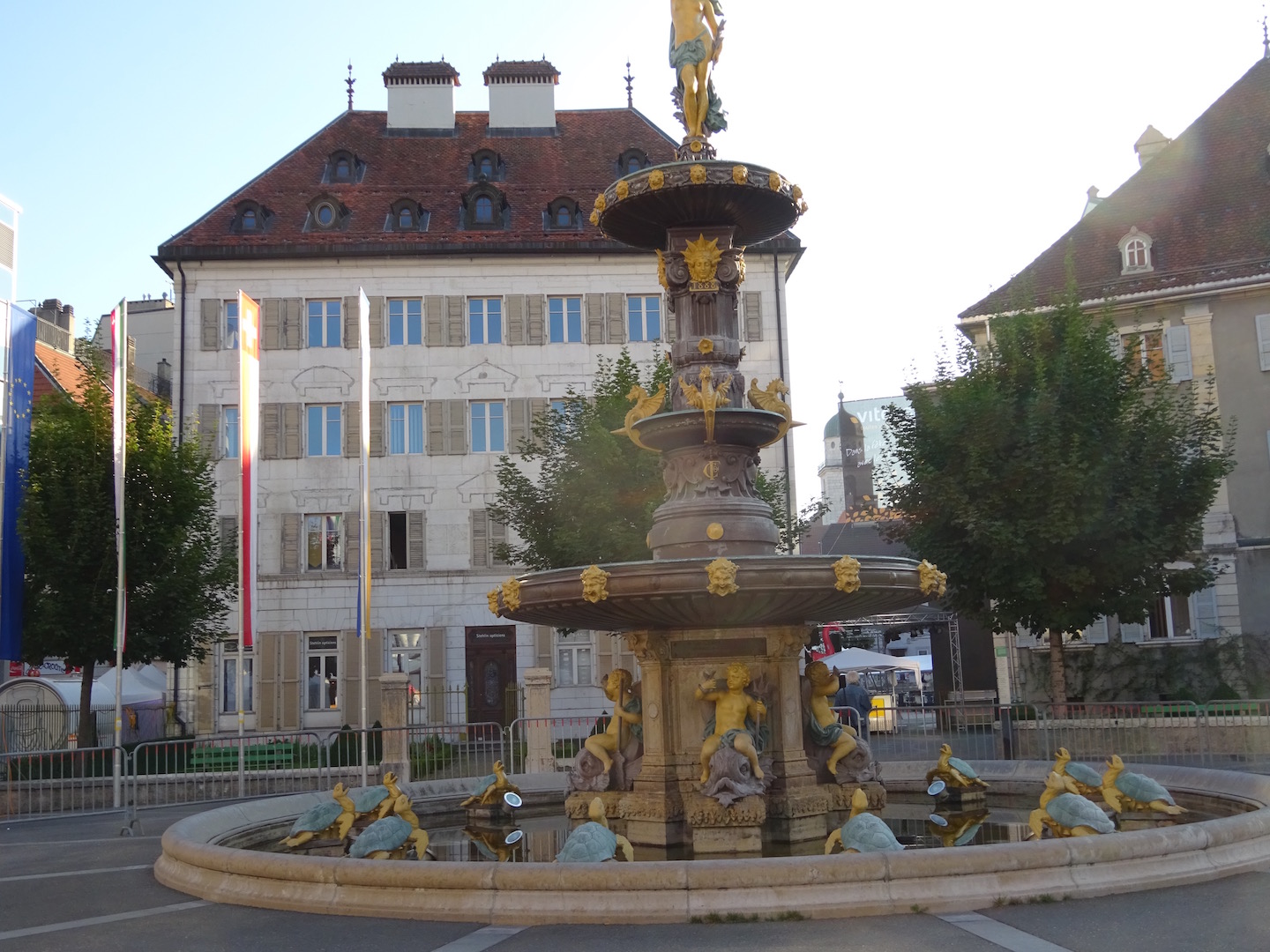
I was here 25 years ago and again 20 years ago to visit corporate headquarters. In the photo you see a tall tower which is something new--the sphere whisks tourists up to the top for a photo opportunity.
This picturesque former fortress city is awash with medieval fortifications including bastions, steep ring walls, ramparts and tower gates---which is why I'm back.
Steep gorges cut through the city
If you look way in the background you can see tall buildings. That area is home to several important European Union institutions including the European Court of Justice and European Investment Bank.
Luxembourg doesn't have a king but, a constitutional monarchy headed by Grand Duke Henri. This used to be the royal digs but, when Grand Duke Henri took over from his father in 2000 he decided city life wasn't for him and moved out to a castle in the suburbs. He still keeps an office here for official duties and meeting foreign dignitaries (such as me).
When I was here to visit companies it turned out to be a joke. Headquarters for about a dozen of the companies consisted of nothing more than a post office box or mail drop. Seems Luxembourg is a tax avoidance haven for hundreds if not thousands of multinational companies. Corporations register in Luxembourg and reap the tax benefits. Here's a question that needs looking into: why do 250 foreign financial institutions have offices in tiny Luxembourg? After Qatar, Luxembourg is the world's richest country.
Back in 1996 I visited steelmaker Arcelor. In 2006 Lakshmi Mittal, CEO of steelmaker Mittal Steel (based in India), launched an audacious takeover of Arcelor and was successful. It's now the world's largest steelmaker (ArcelorMittal) with over $76 billion in revenues AND, its CEO Lakshmi Mittal is one of the world's richest men with an estimated fortune of $11.7 billion. Though he's the big boss, Mittal doesn't live here but in very palatial pad in London. I took this photo of Arcelor/Mittal's building and chuckled in finding several Indian/curry food places close by.
Yep, I'm back to do a more thorough inspection of Luxembourg's medieval fortifications. Why? For one thing the whole city is designated a Unesco World Heritage site. French military engineer Sebastien Le Preste de Vauban (1633-1707) had a hand in their design. Vauban's design principles were the dominant model of fortifications back in his day. I took a self-guided two hour walk showcasing Vaudan's works. Over the centuries the French, Germans, Austrians and even the Dutch controlled the city.
Living down in the deep gorges meant hoofing it up steep grades. This industrial-size elevator whisks pedestrians as well as cyclists up the hill. The red, white and yellow van is a driverless vehicle taking locals home.
View of ramparts.
Homes down in a gorge.
A medieval city gate sill standing in Luxembourg city.
Leaving Luxembourg city I make my way down to Colmar, France. Known as the "Venice of France" because of it's picturesque canals and beautiful old town Colmar (population 90,000) ranks as one of my favorite places in France. I've posted photos multiple times.
My plan to spend the night in Colmar doesn't pan out thanks to cyclists--to be more specific----many, many cyclists. I read about a brand new hotel recently opening in downtown Colmar and that's where I was hoping to lay my head. So, imagine my surprise upon arriving in town late in the afternoon to barricaded streets, crowds of people and big police presence. Jeez, it turns out the Tour de France will be coming through in a few minutes.
Quick background on the Tour de France. It consists of 21 day long stages over 23 days and covers about 2,200 miles. The route changes every year and towns/cities vie to be on the route AND for the race to spend the night in their community. Why? This traveling circus (riders, support staff, media, advertisers, officials and so on) numbers about 4,000. Besides being an economic boom for the community there's the international media coverage. Sometimes the Tour de France goes through other countries and I was Lausanne, Switzerland when the Tour de France spent the night in town.
So, when I heard the Tour de France was not just passing through Colmar but, spending the night here I knew I had to get out of the area quickly because it'll be difficult finding a place within 30-40 miles (as mentioned before I don't book hotels in advance as I like having maximum flexibility). I ended up cycling to Freiburg, Germany 30 miles away. That's Breisach, Germany (population 16,000) in the photo above taken before I crossed the Rhine river into Germany.
Subscribe to:
Posts (Atom)