Friday, September 24, 2010

Strasbourg, Nancy & Metz, France

I sent you pictures from Strasbourg last year. But, was cycling through the city around 7AM on my way to Nancy and snapped a few photos. Strasbourg is one of my favorite cities--thanks to ownership being wrestled between France and Germany four times in the last 120 years.


This is still Strasbourg.

I don't particularly care for Nancy (population 105,000) but, Stanislas Square ranks as one of the most beautiful squares in the world. In 1983 UNESCO made it a World Heritage site. Think of UNESCO, part of the United Nations, as a world historical site agency.


This is one of several surviving magnificent medieval gates to the city center of Nancy.

Nice walkway.


I love this tower gate guarding the entrance to the city center.


Another gated entrance to Nancy's old town.


Backside to gated entrance in photo above.


Close-up of golden gates in Stanislas Square.


Tree-lined walkway to government building in Nancy.


I've been to Metz (population125,000) before but I'm back for two reasons. Medieval French military engineer Vauban (I'm on a mission to visit his works) oversaw the reinforcements of the city's fortifications in 1674 and during World War ll the city was heavily fortified. Well imagine my disappointment to learn there's nothing left to see. Zilch, nada, zippo. Everything has been either torn down or as in the case of some World War ll structures in the outskirts of town--lost to the undergrowth. Other than the yellow limestone cathedral pictured here, Metz scores low on my list of "favorite cities in France".


Molsheim, France (Bugatti cars)

It was 6:30 PM when I arrived on the outskirts of Molsheim (population 10,000). I was hungry and still didn't know where I was spending the night. Lucky me comes upon a McDonald's. Funny story is that you always read about the French bashing American fast-food and in particular McDonald's. Yet, every McDonald's I visit in France is ALWAYS packed. Leaving McDonald's I glance across the road and see a huge fenced-in property with modernistic buildings. Normally, nosey me would find the entrance and take a look but, considering the time of day and I still had to cycle into town to find a hotel I stuck my camera through the openings in the metal fence and snapped photos. Continuing several hundred feet down the road I come across the chateau pictured below. A sign posted near the metal fence gives me the lowdown.

Mention the name Bugatti to a car enthusiast and watch their eyes light up. A buyer back in 1987 paid a cool $8.7 million for a 1931 Bugatti Royale Kellner Coupe--the most ever paid for a car. In 1909 Ettore Bugatti (originally from Milan) settled in Molsheim, France (then part of Germany) and started his Bugatti factory. His cars scored over a thousand victories between 1924-1939 during Grand Prix car races such as Le Mans.

For a variety of reasons the company went kaput and in 1998 Volkswagen bought Bugatti. The first photo (with the modernistic buildings) is the assembly site for the Veyron---the fastest road legal production car in the world. If you're looking for a car with bling-bling and that'll be a babe magnet this will do the job. Prices START at $1.7 million. About 100 a year are assembled here. There are only 10 authorized sales dealerships in the USA with one being Symbolic Motor Car Company in La Jolla (7440 La Jolla Blvd.).

The spiffy-looking chateau in the second photo was built in 1857 and bought by Ettore Bugatti in 1929. Did he live there? Nope. This is where purchasers of Bugatti cars were invited as guests. Since 2001 it's been the head office for Bugatti.


A half mile down the road from Bugatti I come across the Bugatti Hotel and end up spending the night. It's modern, rooms are very small and nary a sight anywhere in the building of any Bugatti memorabilia. Couldn't figure out why this place was only sporting two stars (out of possible five). Turns out if they had a restaurant it would be a three star property.


Molsheim has a nice old town in the city center.


This was a Jesuit church (built 1615-1617).


Tower gate built in 14th century.


Too bad this woman didn't speak english as I'd have loved to have learn more about her collection of "things" mounted on the side of her house.


Storks in an enclosure. Hmmm, are they being rehabilitated or being fattened up for din-din?


Thursday, September 23, 2010

Fort Mutzig, France

I'm on a hill several miles from the town of Mutzig, France and just finished a three hour tour of massive Fort Mutzig. Wow, what a place! Built between 1893-1916 by the Germans when this region was part of Germany it's a monument to the state-of-the-art military technology of that era. This underground concrete fortress housed 6,500 soldiers. Let me repeat that fact: this UNDERGROUND fortress housed 6,500 soliders! Its size (630 acres, 400,000 square feet of underground space and 22 artillery turrents) and the fact it was fully armored, ventilated and lit by electricity made this the strongest, most modern and most powerful fortress in Europe. The first photo is the entrance where the tour starts.

Soldiers slept in shifts on bunks. Straw mattresses were used and changed regularly in order to avoid parasites and mold.

One of six industrial-size kitchens.

One of four power stations.

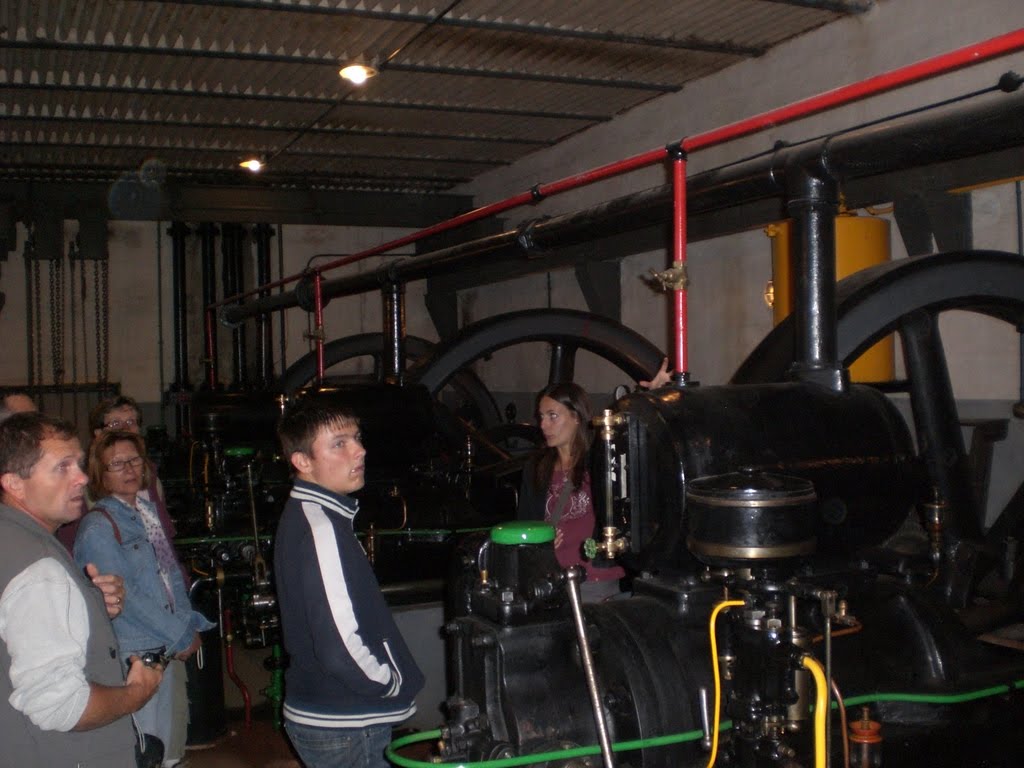
The tour was in French but I followed along with a pamphlet in English. The were about 10 in the group and the downside to this guided tour was the idiot moron who took pictures and asked questions about absolutely everything. So, this normally two hour tour took three hours. Example: a room with glass displays showing various uniforms worn by the soldiers where most people would spend less than five minutes----this idiot moron spent 20 MINUTES snapping photos, checking out each part of every uniform--even the tour guide was rolling her eyes. It's not like you can leave the group and move along to another section because you're four floors below the surface in damp, poorly lit tunnel/corridors that go for miles in multiple directions.

This is an artillery observation point enabling troops to spot the enemy and direct cannon fire.


This is the most fascinating piece of equipment seen. Peering over a wall can get one killed by snipers so, a soldier (most definitely someone small) gets inside this steel plated cannister (note the wheels on the bottom) and is then pushed to the edge of a low wall where the soldier can peer out of the slot near the top and note enemy movements.


This is known as a shielded battery. Built in 1899, you've got 105 mm cannons including an armoured turrent. Underground are dormitories, toilets and a kitchen. It was designed for complete independence for living and battle conditions and it is not linked to any other part of the fort by a tunnel.


Tuesday, September 21, 2010

Selestat, France

Selestat, population 20,000, lies in the midst of the famous 100 mile Alsace wine route. Stunning countysides filled with vineyards mixed in with picturesque medieval villages make this area very popular with tourists.


Selestat's old town is a delight for the eyes as well as the stomach. You are aware the name of this blog is "Paul The Junk Food Junkie"? Well, I have to confess I screwed up. In a patisserie I opted to try a raspberry eclair. In the USA your choices usually consist of chocolate, vanilla and mocha/coffee. In France pistachio and raspberry filled eclairs can be found. Well, the raspberry eclair was historic! This called for a picture of this delightful delectable but, to my considerable dismay the raspberry eclairs were all sold out when I returned!


In the photo above do you see anything unusual atop one of the the buildings? How about in the photo below? Yep, those are storks nesting atop the chimney and they're very common here in the Alsace region. Matter of fact there's a combination zoo/amusement park several miles from Selestat that touts the fact that over 50 storks are born there every year. Yeah that's fine and dandy but I think the locals need to do a better job in pushing the storks as tourist attractions. Why? Standing outside the window display of a butcher shop in the old town area I note the huge glass jars (much taller than wine bottles) and wonder what kind of bird is it that I see packed in the jar floating in a clear liquid. Wow, are those stork legs I see? My question is quickly answered as I peer at the jar's label and see a drawing of a stork. Hmm, would be like going to the San Diego Zoo and seeing the koalas then heading to a nearby restaurant and finding koala burgers on the menu.


Monday, August 16, 2010

Haut-Koenigbourg Castle near Orschwiller, France

I’m in the Alsace region of France, an area roughly 3,000 square miles bordering Germany (about the size of Delaware). Over the years (and many wars) France and Germany have fought over this territory. In 1871 the land was part of Germany and in 1899 Emperor Wilhelm II (or Kaiser Wilhelm) wanted to, for loss of a better phrase, “mark his territory” so, Haut-Koenigsbourg Castle, which had been in ruins for several hundred years was rebuilt----not as an imperial residence but as a showpiece. Perched majestically atop a high hill (2,600 feet) the castle was carved into the rocks to preserve its strategic and defensive position.

This first photo shows the castle way off in the distance. It was taken eight miles away (using the zoom lens) in the town of Selestat. When you start to get closer to the castle you lose sight of it due to interference of hills and heavy forests blocking the view.

The castle is major tourist attraction receiving over 600,000 visitors a year. Matter of fact, when you get to the top there are no parking lots so, I passed people parking their cars alongside the road more than a mile down the hill. I count four French policeman stationed near the castle entrance roadway mostly to prevent French drivers from blocking the road with their usual double and triple parking.


The pink sandstone gives the castle its unique look.It took eight years to rebuild the castle (1900-1908) with the latest technology being used including building a railway line up the hill to ferry supplies (taken apart when the castle was completed).
Built on a rocky spur on the hilltop, you have views of several different valley floors. As you can see it's a cloudy day. A half hour after snapping this photo it started raining.


Cycling down to the vally floor you pass through several stunningly beautiful villages with their half-timbered homes and colorful flowers.

Friday, July 23, 2010

Courmayeur, Italy

Make a list of Italy's upscale ski resorts and Courmayeur will surely rank near the top. Location has something to do with it as Courmayeur lies nestled next to Mt. Blanc. At 15,782 feet, Mt. Blanc or Mt. Blanco in Italian, is the highest mountain in the Alps. Courmayeur is a beautiful place but, I'm not a happy camper. Why? For the past several weeks most of Europe has been experiencing hot, hot weather weather (mid 90's) with no relief in sight. So, I figure high up in the mountains it'll be much cooler. Not so, as you can see in the second photo the temperature reads 31 degrees Centigrade which converts to 92 degrees Fahrenheit!

Temperature reading at ski lift.
This roads leads to the Mt. Blanc Tunnel


Courmayeur's main shopping street is car-free.


More of shopping street.

View of Courmayeur from other side of valley.


Checking out chalets on the outskirts of town


View from above town.
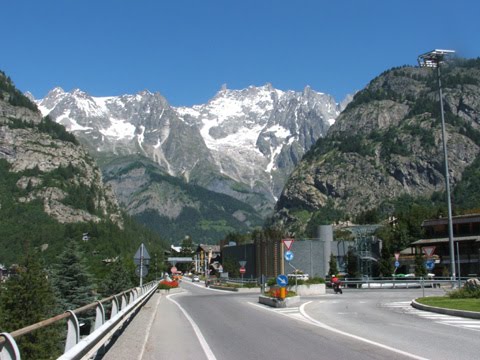

A glacier is up the canyon


New ski lift.


If one were to start in the ski resort of Courmayeur, Italy and dig a tunnel directly through Mt. Blanc one would pop out on the other side into the famous ski resort town of Chamonix, France. Hey wait a minute! that's already been done and it's called the Mt. Blanc Tunnel. Built in the 1960's the Mt. Blanc Tunnel is a major transport route for freight through the Alps. Back in 1999 there was a horrific fire in the tunnel caused by a tractor-trailer truck catching fire. Over 39 people were killed and the tunnel was closed three years for repairs. I mention all this because bicycles are prohibited so my bike and I are hopping on a bus for the ride.
The tunnel is seven and a half miles long and very narrow with one lane in each direction. The fire changed the ways things are now done; every truck is inspected before being allowed to enter the tunnel plus, vehicles are required to maintain a distance of 150 feet between each other. About midway through I look up at the tunnel roof and it's still scorched black from the fire. Jeez, that's not something comforting to see--why didn't the powers-that-be have it covered or painted over?
I've been to Chamonix several times before and like previous visits it's absolutely bursting with energy and people. Courmayeur was like a ghost town compared to Chamonix. Why is that? Chamonix is action central with hang gliding, rock climbing, hiking, mountaineering, off-road biking, camping, golf and so forth taking place. Only snapped a few photos this time since you've received plenty of pictures from previous visits.

My favorite partisserie in Chamonix is right around this corner.

Main shopping streets in Chamonix are pedestrian-only (no cars!)


Thursday, July 22, 2010

Wangen im Allgaeu, Germany

First mentioned in 1472 and in its current appearance since 1608, Ravensburg Gate, with its Renaissance-era artwork, gives visitors to Wangen im Allgaeu (population 25,000) an eyeful.


It's always nice to find a fountain spewing cold water to fill my water bottle.


Medieval walls still encircle Wangen im Allgaeu's old town.