Sunday, August 11, 2024

Leysin, Switzerland (mountain village/ski resort)


You can't miss seeing this ski jump as it's on the side of the main road (and only road) as you enter Leysin (population 4,000). You can see skiers atop. I watched them ski down (through water sprinklers) make the jump and, go flying onto the foam padding. 

Entering Leysin's town center. Note that big white building high above--more on that later.  
Chalets above town center.
This is the entrance to the Swiss Hotel Management school. It's rated one of the best hotel management schools in the world. The main campus is located about 30 miles away in Montreux. Formerly the Mont Blanc Palace hotel, the school purchased the property in 2004. I saw these kids playing out front and they sure didn't look old enough to be going to this school. I had to investigate. 

Turns out hotel management school is on summer break and they offer summer school classes (English, math etc...) for young kids. The kids hail from around the world. Talked to several from China and Brazil. 

Directly below this building is that large white building I pointed out to you two previous photos ago. It's part of the Swiss Hotel Management school.
Went inside the Swiss Hotel Management school and they let me snap this photo from a balcony. This former hotel (Mont-Blanc Palace) has quite a history.

Ever heard of Club Med? It's a French company that back in the 1950's started offering all inclusive destination holidays (meaning room, food and drinks were all included for one price). Club Med properties were usually in tropical climates but, in 1950 this hotel became Club Med's first skiing, winter sports location. 

This is Leysin's train station---a cog railway line was built from the valley floor to here back in 1897.  I thought this was the end of the line but, turns out I'm wrong as it continues up through the mountain to a private train station. 
The train leaves Leysin's main station and continues up through the mountain for a distance of about three blocks--coming out behind this hotel---the historic Grand Hotel. 

Back in the 1890's tuberculosis was a scourge around the world. Affecting primarily the lungs and very contagious, there were no drugs/antibiotics back then to fight this disease. It was thought fresh air was the cure. Leysin was picked as the perfect site for the "cure". Why? Lots of sun, low humidity, thin air plus, being located on the south side of the mountain protected Leysin from cold winds. 

Soon, Leysin became famous throughout Europe and sanatoriums (specialized hospitals) sprung up around town. The Grand Hotel was the top-of-the-line place to stay. 


This is the end-of- the-line private train station located directly behind the Grand Hotel.

This is the backside of the Grand Hotel. See that walkway leading into the hotel?  It's only about 20 feet from the train station.  So, back then ((1890-1920's) tuberculosis passengers rode in separate train compartments (TB was contagious) and could discreetly enter the hotel (you were shunned and looked down upon if you had TB).

At one point (1930), Leysin had over 3,000 patients. The "cure" rate was three out of four (75%)--with 25% dying.  How long did this "cure" take. Up to three years! Jeez, that's a lot of time soaking up the big air!

This is the front side of the Grand Hotel. Three pictures earlier I showed you the far end of the hotel --the oldest section. So, what's going with this place now? 

In the late 1920's penicillin was one of the drugs helping in the fight against tuberculosis. Soon, there other drugs and slowly Leysin lost its luster. A German travel operator bought the Grand Hotel and brought in tourists.  

In 2008 Leysin American School bought the 100,000 square foot building on 10 acres and in 2010 opened after renovations. Leysin American School gobbled up a slew a buildings in Leysin and has  quite a campus. How can the school buy all the buildings? Well, it's one of the world's most expensive (if not the most expensive) boarding schools--where sending your kid to school here for one year will set you back $155,000. Multiple that by 300 students and it adds up. 
An old chalet near Leysin's town center. 
Restaurant in Leysin's older section.
Another restaurant and homes in Leysin's old section. 
Coming down from Leysin I can see that massive bridge I cycled across after leaving Les Diablerets.

A zoom view of the bridge over the gorge. 


Friday, August 9, 2024

Les Diablerets, Switzerland (village/ski resort)

I've posted pictures of Les Diablerets (population 700) several years ago on my blog. I'm back here to check out a few things.
 
The Les Diablerets International Film Festival is happening this week. It started back in 1969 and is the world's second oldest mountain film festival--meaning the films have to have something to do with mountains. A mountain film festival in Trento, Italy is the oldest. 
Movies have their screenings in the community center next door to this hospitality tent. Here you can find all kinds of mountain specialities to eat. Even better, there's no smoking allowed inside--which is unusual in smoke-happy Switzerland. 
My other reason for visiting Les Diablerets was to cycle up to Col du Pillon, the mountain pass. This is it and, where you catch the cableway up to the mountain peak.
You can barely see the cableway finish way up the top of the mountain peak.
The whole experience is called Glacier 3000.  I'd seen photos of a very cool-looking toboggan run, the highest in the world. I thought it was here at the mountain pass, but no, you have to take the cableway. 
View of Les Diablerets as I cycled down the mountain on my way over to Leysin, another ski resort/mountain village.


Friday, August 2, 2024

Neuchatel/Lake Neuchatel, Switzerland (Part 4)


Every 40-50 years Switzerland puts on a national exposition--sort of like a mini world's fair. The last fair was in 2002 and Neuchatel was the host city. This is when the 5 star Hotel Palafitte was built on Lake Neuchatel It's the only hotel in Europe built on stilts.

It looks pretty cool, right? I'd only want to stay here in the winter. Why? Because then you wouldn't have to deal with pesky gnats, mosquitos and others insects playing havoc in the summer. 

That's the hotel restaurant in the center deck.
I'm about a half-dozen miles from Neuchatel and had to snap this photo from across railroad tracks. Why? Those buildings you see in the distance belong to Metalor Technologies and it's the only way to get the head office building (on the left) and factory complex in one photo. 

Some of the world's biggest gold refineries are located in Switzerland and Metalor is one of the "big boys". Some 70% of the world's gold is processed in Switzerland. 

Back in the summers of 2003 and 2004 I cycled around Switzerland visiting over 100 watch companies as well as watch-related companies. I tried to visit Metalor's head office near Neuchatel's city center back in 2003 but was rebuffed by the company's lawyer. Since my attempted visit Metalor has changed hands several times and is now owned by a Japanese company. The head office moved here next to the factory in 2016
Metalor has been around since 1852 and back in 2003 had over $250 million revenues with 1,500 employees. Watch companies use plenty of precious metals (gold and silver) in their products. 
Cycling around the property's perimeter I was curious as to their security--yep, the usual cameras and fences are in use.

I remember visiting Chopard (maker of high-end watches) and during a tour of the factory was shown gold and silver bars being melted. I've always wondered how they transported the  precious metals to the watchmakers. Do they use armored trucks? UPS/Federal Express/post office? Unmarked cars? Guys on motorcycles? Of course, watch companies don't talk about such things. 

 This is the main factory entrance to Metalor and my plan was to hang around the entrance eating my lunch and watch the comings and goings. I got bored after five minutes and pedaled off.  
Beautiful farmland. That's Lake Neuchatel off in the distance. It's about a 65 mile ride around the lake. Lake Neuchatel is Switzerland's third largest lake (behind Lake Geneva and Lake Constance) but, is the largest lake entirely in Switzerland. Lake Geneva shares its shoreline with France and Lake Constance with Germany. More trivia: Lake Neuchatel is Europe's 59th largest lake. 
Flowers add to this church's look.
Flower's add to this hotel's exterior.
It's farming country and a smell brings me to a stop. What's this growing next to fields of corn? That there is tobacco. Over 350 farmers grow tobacco in Switzerland and this region is awash in the killer plant. 

Tiny village with seemingly mandatory church. 


Thursday, August 1, 2024

Neuchatel/Lake Neuchâtel, Switzerland (Part 3)


 In the USA we have states, in Switzerland they have cantons (27 of 'em). Neuchatel (population 33,000) is the capital of the Canton Neuchâtel. Way up on a very steep hill overlooking the old town is Neuchatel Castle, which houses offices of the cantonal government. 

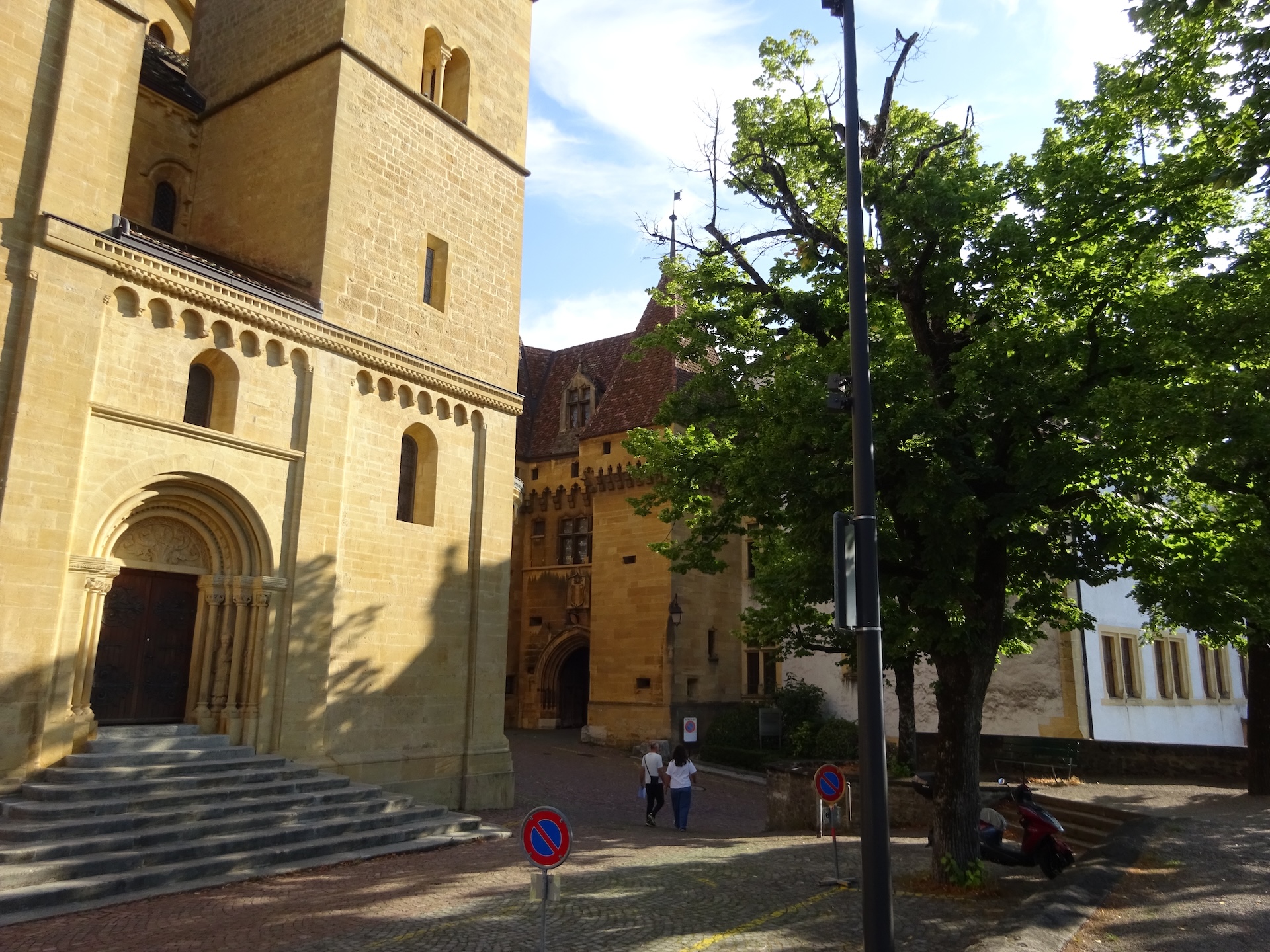
On the left, that's a side entrance to Collegiale, a Gothic church dating back to the 11th century. To the right in the photo is Neuchatel Castle, which dates back to the 12th century. 


Here's a partial view of Neuchatel Castle. 

This is the entrance to Neuchatel Castle. What's extraordinary is the enclosed walkway structure to the left of the entrance. Why? It connects to Collegiale church. Don't think back in medieval times they practiced separation of church and government.
That medieval tower is the old prison.
Parts of medieval walls can still be seen.
Neuchatel has over 140 street fountains. The vast majority aren't fancy as the one's I've posted. This is some kind of lion with wings.
Here's a side view of the fearsome-looking creature.
Street view in downtown Neuchatel.
I strike gold at this pastry/sandwhich shop.
I grabbed a roast beef along with a ham sandwich and both were delicious. 

As you know I have a sweet tooth and one of my favorites is a Paris Brest. The third row from the left you see three Paris Brest. Similar to cream puffs, Paris Brest are baked with almonds and then filled with a praline cream and, in this case a sprinkling of crunchy hazelnuts are added. I've tasted hundreds of Paris Brests and these are absolutely magnificent! 

Paris Brest is a famous one day bike ride from Paris to the port city of Brest in Northern France. In 1910 a French pastry chef came up with this treat. 
Back in the summers of 2003 and 2004 I cycled around Switzerland visiting over 100 Swiss watch companies. I remember receiving a bizarre reception here at Bulgari. Back then I checked in with the two receptionists to find out who ended up with my letter of introduction sent weeks earlier.  I was repeatedly told to contact the head office in Rome AND, was told no watches were manufactured here. 
A week later I was visiting another watch company and met a woman who had worked for Bulgari for years. I told her what happened to me and she was dumbfounded. She said over 400 employees worked in the building making watches.  
This is a photo from the rear of the building as I wanted to include the trash dumpster. I hold no grudges. 

Here's the front entrance to Bulgari. To read the story of my visit back in 2004 go to my website: corporatetrivia.com, then click on the "watches & chocolate" heading, then scroll down.


Tuesday, July 30, 2024

Neuchatel, Switzerland (Part 2)


I'm still making my way around Lake Neuchatel, the largest lake located entirely in Switzerland. This is Colombier Castle which dates back to the 1500's. Located in Colombier (population 5,000), it's still used as a federal military training center.

A view of the entrance into Colombier Castle.
That's Lake Neuchatel with vineyards. Switzerland produces quite a bit of wine. Why don't you ever hear about Swiss wine? Not much is exported as the Swiss drink most of it. 
Cycling though farming villages I unexpectedly come across this complex of new buildings in the outskirts of Boudry (population 6,000). It's a new campus for Bristol Myers Squibb, the big American pharmaceutical company ($47 billion in revenues, 34,000 employees). 
To the right of the Bristol Myers Squibb buildings in the previous photo are two new company buildings rising up. Wow, I corner a woman coming out of the main building and learn the whole complex is a global product supply function/administrative/manufacturing facility with several thousand employees. 
Surrounded by farmland, this is a view of the backside of the Bristol Myers Squibb campus. 
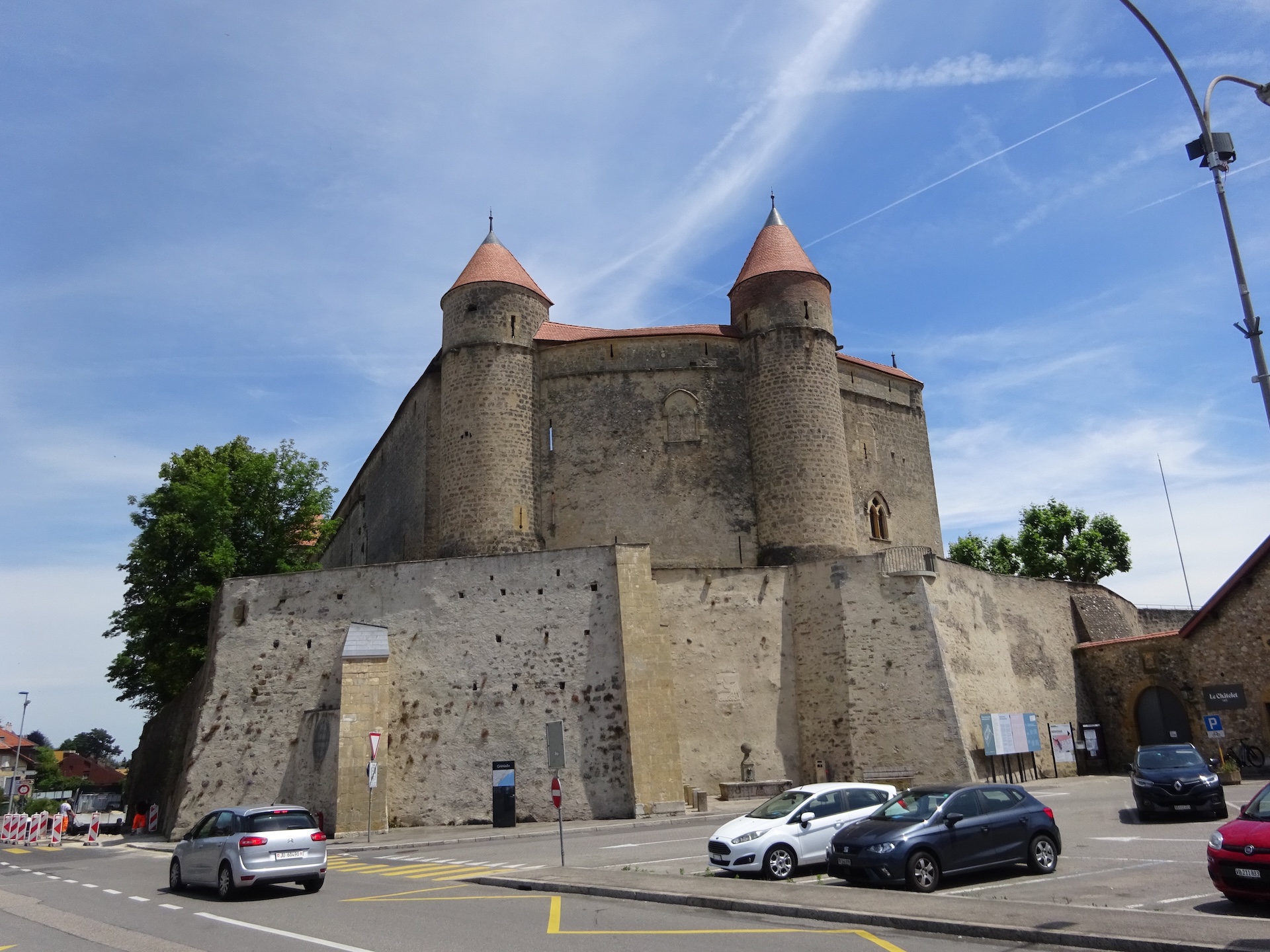
The main street running through Grandson (population 3,300) takes you past medieval Grandson Castle.
Grandson Castle dates back to the 11th century. 

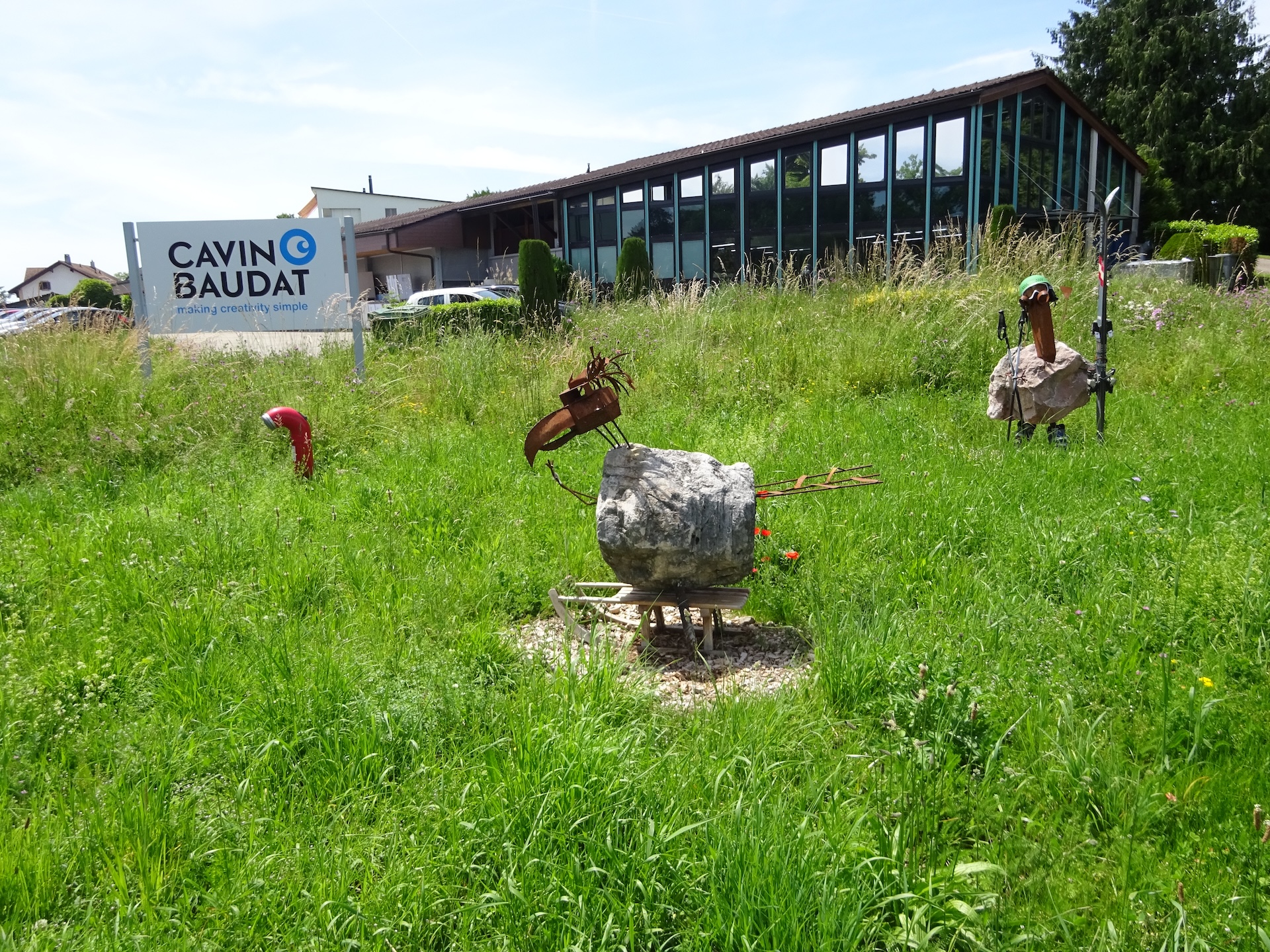
These crazy looking rocks reside on the side of the road as you leave Grandson.